In our first article, we described the mouth as a physiological interface. In our second, we followed a performance ingredient from the moment it enters the mouth to the moment it produces an effect. In our third, we asked whether an athlete will actually use a product, and why convenience and compliance matter as much as formulation. This article returns to the physiology and zooms in on one pathway: how a molecule crosses the lining of the mouth and reaches the bloodstream.
It is a question pharmaceutical scientists have studied for decades. Sublingual nitroglycerin, placed under the tongue, starts to widen blood vessels within 1 to 3 minutes (OpenAnesthesia). Nothing is swallowed and nothing waits for the stomach to empty. Performance nutrition has largely ignored this route.
A route medicine already uses
Oral transmucosal delivery is established pharmaceutical science. Products approved for sublingual or buccal use include nitroglycerin for angina, nicotine gum for smoking cessation, buprenorphine for opioid dependence, fentanyl for breakthrough cancer pain and grass-pollen allergy tablets (Bahraminejad & Almoazen, 2025). They come as tablets, lozenges, sprays, chewing gums, films and patches.
Medicine uses the route for three main reasons: a rapid onset, avoiding first-pass metabolism in the gut and liver, and a non-invasive alternative to injection (Bahraminejad & Almoazen, 2025; Shojaei, 1998). It also has well-known limits: low permeability to large molecules, a small surface, and saliva that dilutes the dose and carries it away to be swallowed.
Pharmaceutical scientists have spent decades learning to work within those limits. To understand them, and what it would take to use this route well, we need to look at the physiology: the tissue, the barrier, the forces that move a molecule across it, and the blood vessels waiting on the other side.
The mouth is not one surface
The adult mouth has a total surface area of about 215 cm² (Collins & Dawes, 1987). Teeth make up around 20% of it, keratinised tissue around 50% and non-keratinised tissue around 30%. That split matters, because the two kinds of lining behave very differently.
Keratinised mucosa covers the gums and hard palate. These surfaces take the mechanical load of chewing, and their outer layers contain lipids such as ceramides and acylceramides that make them relatively impermeable to water (Shojaei, 1998).
Non-keratinised mucosa lines the inner cheeks (buccal), the floor of the mouth and the underside of the tongue (sublingual) and the soft palate. It lacks acylceramides and is considerably more permeable (Shojaei, 1998). This is where oral transmucosal absorption happens.
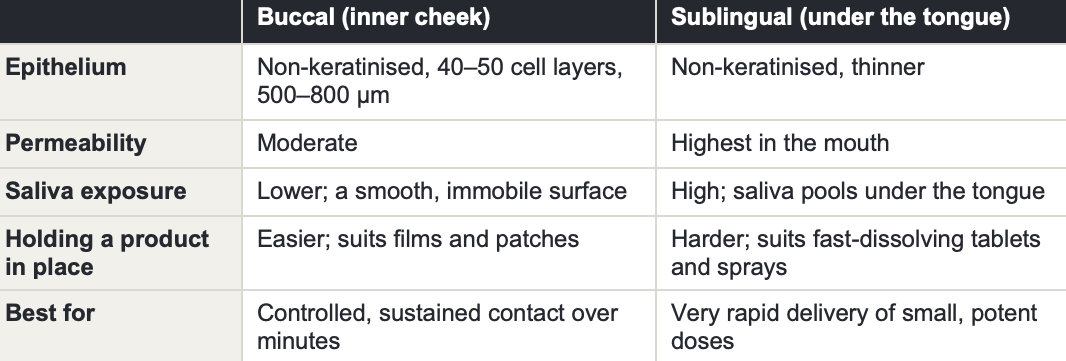
Buccal and sublingual: two different design choices
Permeability falls in the order sublingual, then buccal, then palatal, and buccal mucosa is estimated to be 4 to 4,000 times more permeable than skin (Shojaei, 1998). Sublingual is the faster door; the buccal surface is larger and more stable (Collins & Dawes, 1987; Shojaei, 1998).
Crossing the lining: saliva, mucus and the epithelial barrier
Before a molecule reaches the tissue, it has to get through what sits on top of it.
Saliva coats the mouth in a film that averages only 0.07 to 0.10 mm thick (Collins & Dawes, 1987), but it is constantly renewed. We produce between 0.5 and 2 litres a day (Shojaei, 1998). Saliva dissolves an ingredient, which is the first step towards absorption. It also carries that ingredient away to be swallowed. Formulators call this salivary washout, and it is a major reason most of what enters the mouth ends up in the gut.
Mucus is a gel of mucin glycoproteins, secreted by the salivary glands, that clings to the epithelial surface (Shojaei, 1998). It lubricates and protects the tissue, and any molecule on its way in has to pass through it.
The epithelium is the real barrier. In non-keratinised tissue, cells in the upper third of the epithelium release the lipid contents of membrane-coating granules into the spaces between them. That lipid seal, in the outermost 200 µm or so, is what limits penetration (Shojaei, 1998).
Two routes through:
Paracellular: between the cells, through the water-filled spaces they share. Small, water-soluble molecules tend to take this route.
Transcellular: through the cells themselves, dissolving into and out of each cell membrane. Lipid-soluble molecules tend to take this route.
Most real molecules use both to some degree. Which one dominates depends on size, charge and how the molecule balances between water and fat.
Diffusion and flux: the physics of getting in
There is no pump moving most ingredients across the oral mucosa. They move by passive diffusion: molecules spread from where they are concentrated (the product) to where they are not (the tissue and blood beneath). The rate of that movement per unit area is called flux, and it is described by Fick’s first law:
J = (D × K × ΔC) / h
J is the flux: how much crosses each square centimetre of tissue per unit of time.
D is how easily the molecule moves through the tissue.
K is the partition coefficient: how strongly the molecule prefers the membrane over the product it comes from.
ΔC is the concentration difference between the surface and the blood. This is the driving force.
h is the thickness of the barrier.
Flux tells you the speed per square centimetre. The total amount absorbed depends on two more things:
Amount absorbed ≈ J × A × t
where A is the contact area and t is how long the contact lasts, the residence time. Every oral delivery format is, in effect, a different answer to this equation. A mint dissolving in saliva spreads over a large, moving area, but its ΔC is diluted and its residence short. A sublingual tablet works over a small area, but across a thin, highly permeable barrier.
What makes a good candidate for the mouth?
Fick’s law also explains why only some molecules suit this route. Pharmaceutical experience points to a consistent profile:
Moderate size. Small to moderate-sized molecules cross most readily (Bahraminejad & Almoazen, 2025). Very large molecules barely get in: in tracer studies, large proteins penetrated only the outermost one or two cell layers (Shojaei, 1998).
Balanced solubility. The molecule must dissolve in saliva, yet be lipid-soluble enough to enter the cell membrane (Bahraminejad & Almoazen, 2025).
Uncharged at saliva pH. Saliva sits at roughly pH 5.5 to 7 (Shojaei, 1998). Many molecules are weak acids or bases, and their uncharged form crosses membranes far more easily than the charged one. This is why some nicotine gums are buffered to raise the pH in the mouth.
Potency. The mouth’s small surface and modest flux limit how much can cross in a few minutes. The route suits ingredients that work at milligram doses, not grams.
Taste and tolerability. Anything held in the mouth for minutes has to be acceptable to hold there (Bahraminejad & Almoazen, 2025).
From the cheek to the systemic circulation
Once a molecule clears the epithelium and its basement membrane, it enters the lamina propria, a layer of connective tissue threaded with a dense capillary bed. The oral mucosa has a rich blood supply (Shojaei, 1998), and that matters for the physics: blood flowing past carries absorbed molecules away, which keeps the concentration on the far side low and the driving force, ΔC, high.
From the capillaries, blood from the cheek drains into the buccal and facial veins, and through the deep facial vein from the pterygoid venous plexus (Kenhub: facial vein). Blood from the tongue and floor of the mouth drains through the lingual veins (Complete Anatomy: lingual vein). Almost all of this blood reaches the internal jugular vein, then the brachiocephalic vein and superior vena cava, and enters the right atrium (Kenhub: brachiocephalic vein). The blood passes through the lungs before the left heart pumps it into the systemic arterial circulation.
Compare that with the swallowed route. A capsule has to dissolve and leave the stomach before most of it can be absorbed across the small intestine. That surface is enormous, 30 to 40 m² for the whole gastrointestinal tract, against less than 1 m² for the mouth, oesophagus and stomach combined (Helander & Fändriks, 2014). Blood leaving the gut then travels via the portal vein to the liver before it reaches the rest of the body.
So the two routes trade off in a clear way:
The gut has a vast surface and absorbs many ingredients well, but it is slow to start and depends on gastric emptying, which is variable and often reduced during hard exercise.
The mouth has a tiny surface, but it is the first tissue an ingredient meets, and its venous blood bypasses the hepatic portal system and the liver.
That is why oral transmucosal delivery is not about absorbing more. For a molecule the gut already handles well, it is about absorbing earlier, and with more control over timing.
Seeing it: absorption in the mouth, step by step
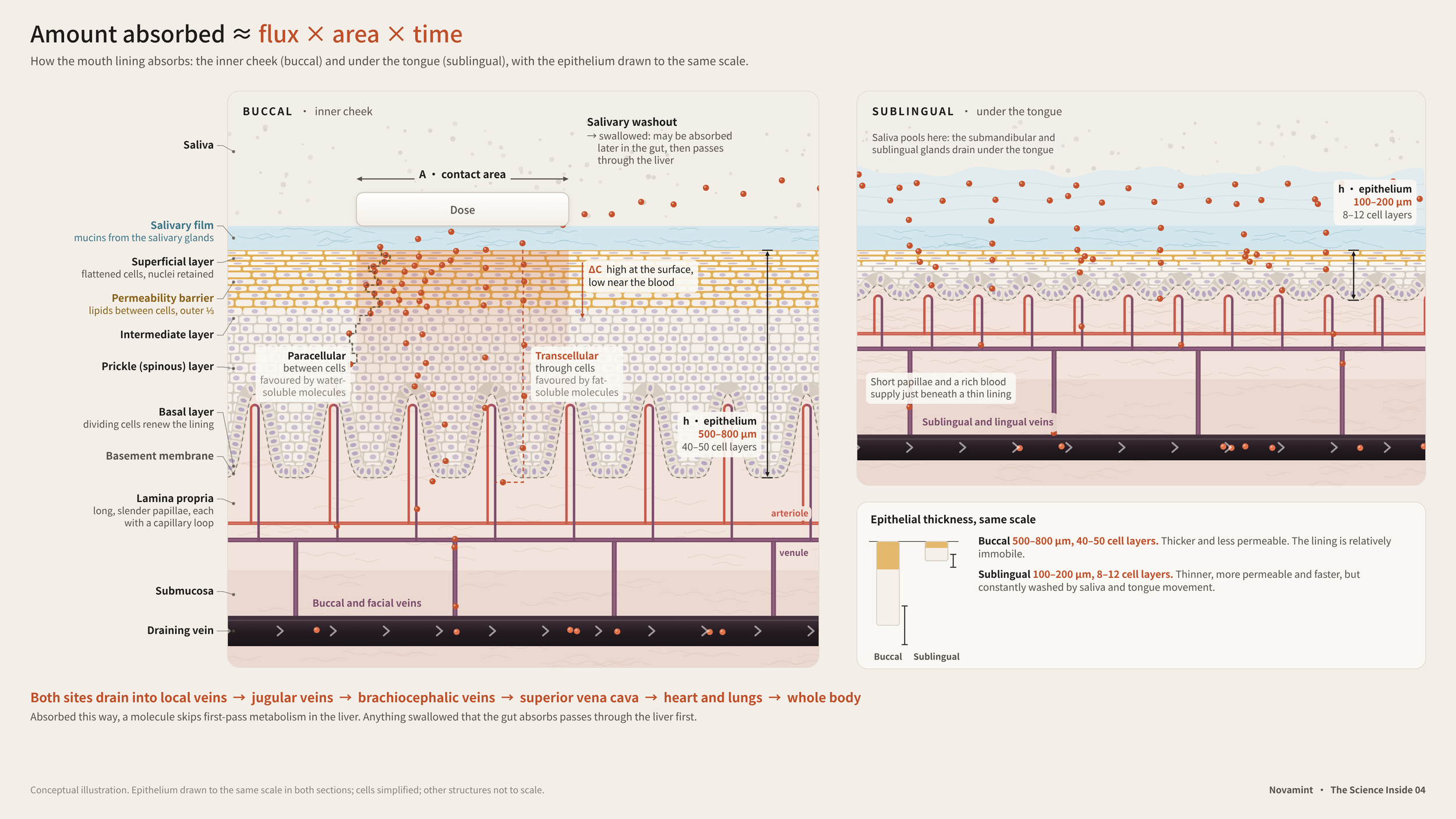
How an ingredient crosses the oral mucosa. Conceptual illustration; only the epithelium is drawn to scale. An ingredient dissolves into the salivary film. Some is washed away and swallowed. The rest diffuses down its concentration gradient, between and through the epithelial cells, past the basement membrane and into the capillary bed, then into veins that drain to the heart. Under the tongue the epithelium is about a quarter as thick as in the cheek.
How an ingredient crosses the oral mucosa, step by step. Conceptual animation; only the epithelium is drawn to scale. An ingredient dissolves into the salivary film on the inner cheek, and some is washed away and swallowed. The rest diffuses between and through the epithelial cells into the capillary loops, then on to the heart without passing through the liver first. Under the tongue the lining is thinner and quicker to cross, but saliva constantly washes over it.
What this means in performance nutrition?
The physiology gives a clear rule of thumb. Oral transmucosal absorption suits small, potent molecules that work at milligram doses, stay in contact with the right tissue for long enough and are not lost to saliva first.
The same caution from our second article applies here. Not every ingredient will cross the oral mucosa. Not every ingredient that crosses it will do so quickly enough to matter. And absorbing earlier is only useful if the timing helps the athlete.
But the physiology is clear about one thing. The mouth is the first tissue every ingredient meets, it is lined in places with thin, permeable, well-vascularised mucosa, and its blood reaches the heart directly. For the right molecule, in the right format, that is a route worth designing for.
That is Oral Performance Science. That is The Elite Way Forward.