
Oral Performance Science
The mouth senses, signals, absorbs and transforms. We are studying what that means for human performance.
The role of oral science in human performance?
For decades, innovation within performance nutrition has focused almost exclusively on formulation: identifying new ingredients, refining dosages, and optimising combinations of bioactive compounds. Comparatively little attention has been given to the physiology of delivery itself.
The oral cavity represents one of the most specialised physiological environments in the human body. Beyond its role as the entrance to the gastrointestinal tract, the mouth contains highly vascularised mucosal tissues (Brizuela et al., 2026), specialised sensory receptors (Simon et al., 2017), saliva with unique physicochemical properties (Schipper et al., 2007), the oral microbiome harboring on average about 50 to 100 billion bacteria (Krishnan et al., 2017), and distinct epithelial barriers (Groeger et al., 2019) that collectively influence how compounds are retained, dissolved, perceived, and, where appropriate, absorbed. These characteristics have made the oral cavity an area of sustained interest within pharmaceutical sciences for several decades (Patel et al., 2011 & Sattar et al., 2014), particularly for buccal and sublingual drug delivery, yet their application within performance nutrition remains comparatively and seemingly under-explored.
Importantly, oral science extends beyond absorption alone. The oral cavity represents the first point of interaction between a nutritional intervention and the athlete. Delivery format determines not only pharmacokinetic behaviour, but also sensory perception, user experience, convenience, compliance, and ultimately whether an intervention can be used effectively in demanding real-world environments.
At Novamint, we believe delivery deserves the same scientific attention as formulation. Our philosophy is founded on the principle that the mouth should be considered an active physiological interface for performance nutrition, rather than simply a route of administration. By applying principles established within oral drug delivery science to evidence-based performance nutrition, we are exploring how intelligent delivery systems may unlock new possibilities for human performance.
References:
Brizuela M, Winters R. Histology, Oral Mucosa. [Updated 2023 May 8]. In: StatPearls [Internet]. Treasure Island (FL): StatPearls Publishing; 2026 Jan-. Available from: https://www.ncbi.nlm.nih.gov/books/NBK572115/
Groeger S, Meyle J. Oral Mucosal Epithelial Cells. Front Immunol. 2019 Feb 14;10:208. doi: 10.3389/fimmu.2019.00208. PMID: 30837987; PMCID: PMC6383680.
Heydenreich J, Koehler K, Braun H, Grosshauser M, Heseker H, Koenig D, Lampen A, Mosler S, Niess A, Schek A, Carlsohn A. Effects of internal cooling on physical performance, physiological and perceptional parameters when exercising in the heat: A systematic review with meta-analyses. Front Physiol. 2023 Apr 11;14:1125969. doi: 10.3389/fphys.2023.1125969. PMID: 37113693; PMCID: PMC10126464.
Krishnan K, Chen T, Paster BJ. A practical guide to the oral microbiome and its relation to health and disease. Oral Dis. 2017 Apr;23(3):276-286. doi: 10.1111/odi.12509. Epub 2016 Jul 4. PMID: 27219464; PMCID: PMC5122475.
Patel VF, Liu F, Brown MB. Advances in oral transmucosal drug delivery. J Control Release. 2011 Jul 30;153(2):106-16. doi: 10.1016/j.jconrel.2011.01.027. Epub 2011 Feb 4. PMID: 21300115.
Sattar M, Sayed OM, Lane ME. Oral transmucosal drug delivery--current status and future prospects. Int J Pharm. 2014 Aug 25;471(1-2):498-506. doi: 10.1016/j.ijpharm.2014.05.043. Epub 2014 May 29. PMID: 24879936.
Schipper RG, Silletti E, Vingerhoeds MH. Saliva as research material: biochemical, physicochemical and practical aspects. Arch Oral Biol. 2007 Dec;52(12):1114-35. doi: 10.1016/j.archoralbio.2007.06.009. Epub 2007 Aug 10. PMID: 17692813.
Simon SA, Gutierrez R. TRP Channels at the Periphery of the Taste and Trigeminal Systems. In: Emir TLR, editor. Neurobiology of TRP Channels. Boca Raton (FL): CRC Press/Taylor & Francis; 2017. Chapter 7. Available from: https://www.ncbi.nlm.nih.gov/books/NBK476105/doi: 10.4324/9781315152837-7
Inside the mouth, step by step
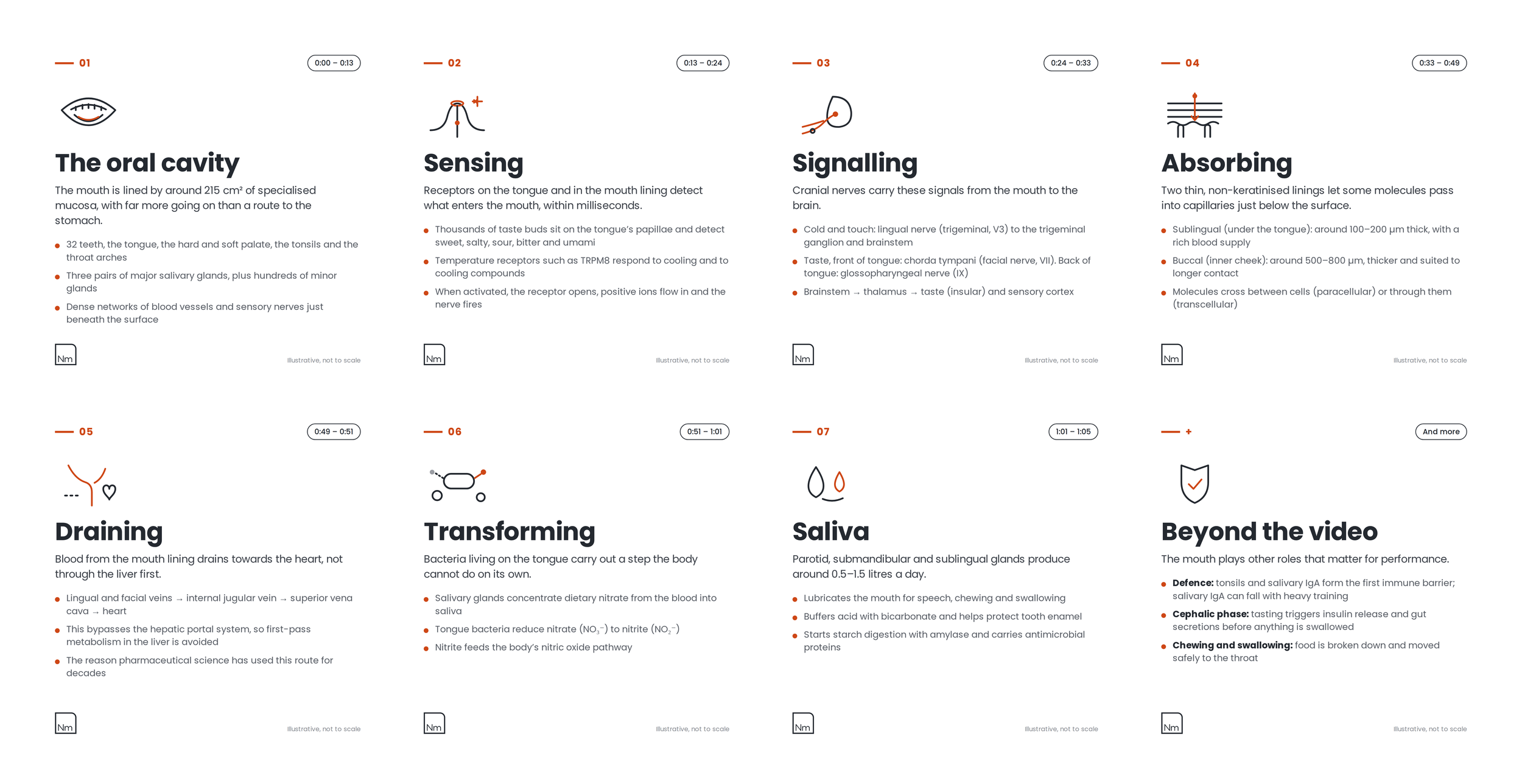
Why the mouth matters (in Enduro) ?
Enduro is our first acute-performance product. Instead of starting with a capsule, powder or drink, we started with the mouth.
Full details coming soon.


We are collaborating with Sheffield Hallam University.
We are collaborating with Sheffield Hallam University to formally investigate our product Enduro’s formulation:
• Delivery format
• Perceptual responses
• Performance outcomes
Our goal is to contribute to peer-reviewed research and progress performance knowledge.

03 - Convenience, Compliance, and Athlete Behaviour
In our previous articles, we explored the oral cavity as a physiological interface and examined what happens to a performance ingredient between entering the mouth and producing an effect. The next question is equally important: even if a product works physiologically, will an athlete actually use it?
02 - What Happens When a Performance Ingredient Enters the Mouth?
In our first article, we introduced the concept of the oral cavity as a physiological interface. The next question is more specific: what actually happens to a performance ingredient in the time between entering the mouth and producing an effect?

01 - Oral Performance Science: Why the Mouth Is More Than a Route to the Stomach?
The mouth is usually treated as a route to the stomach. At Novamint, we believe it deserves to be taken seriously as a physiological interface in its own right, and that thinking is at the heart of Oral Performance Science.